
Edward Harry Temme
Channel and Olympian Goliath
Introduction
Edward Harry Temme, known as Ted and Tammy to friends and family, was a giant of the swimming world – in all senses of the word. Standing 6’ 2’’ in his socks and weighing in at 15 st 11lbs at the age of 23, he was an Olympic sportsman and Channel swimmer pictured on cigarette cards in 1936 which we are delighted to have our own copy of to show you. [1] One of these cards is also in the National Portrait Gallery in London indicating just how famous he was as a celebrity swimmer.[2]
But which Channel are we talking about? Pages of historic press coverage, proud family posts on genealogy sites and interviews by Edward himself give us chapter and verse about his successes (and failures) in the English Channel. He first swam from France to England in 1927 and then had four failed attempts between 1928-1933, trying to become the first person to swim the English Channel in both directions, a feat he finally achieved in 1934.[3]
But, where was OUR Channel: it began to feel like the Bristol Channel was missing in action until, finally, we found a headline telling us that Edward Temme was a ‘Bristol Channel Aspirant’.[4] So, what happened and why was the evidence more elusive? You’ll have to read on to find out!
Edward Temme’s Early Life
Edward Harry Temme was born on 16 September 1904 in Plaistow, Essex, the third child of Edmund Bernard Temme and his wife Rosetta Clara (nee Hart). Edward’s parents had married in Spitalfields on 8 May 1892 and would go on to have five children – Edward being the only boy. [5] The 1911 census tells us that the family were still living at Plaistow and that Edward’s father had his own boot making business, which his mother helped out with. Edward, now aged six, was at school. [5]
Edward’s Early Swimming Achievements
Edward started swimming around the age of 11 or 12 whilst at Water Lane School, using the Balaam Street Baths in West Ham.[6] As a youngster, he joined his local Plaistow United Swimming Club; this had its own water polo team which Edward went on to captain. All this provided a springboard to captaining the Essex county water polo team and eventually the English national team. Edward was selected for the British water polo team at the 1928 Amsterdam Olympics which he followed up by captaining Britain at the European Games in Nuremburg in 1930. Although he missed out on the 1932 Olympics (perhaps because he was so focussed on the English Channel), he was selected again for the British team in the 1936 Berlin Olympics which is the year the cigarette card picture of him was produced.[7,2]
As well as being an elite water polo player, Edward was proving successful at long-distance, endurance swimming. He won the Essex long-distance swimming championship from Leigh to Southend Pier-head, three years in a row in the 1920’s and was also gaining podium places in the ASA Long Distance Championships, swimming the River Thames in 1925 and 1928.[8] Although he was working full-time as an insurance clerk, his employers were providing lots of support and seem to have encouraged him to attempt an English Channel swim.[9]
With the backing of his employer and full of youthful confidence, he told a press reporter in 1927 that ‘I’m going to swim the [English] Channel this year, … and what’s more, I’m going to beat the Frenchman who set up a record by doing it in eleven hours … I’ve trained and trained for two years now, always with the Channel swim in view’.[10] The training that he was doing was with Tom Storey (he would also be an English Channel swimmer) at Leigh on Sea where he was regularly doing 5 or 6 mile swims whilst also being a non-smoker and a teetotaller.[10,11] He was ready for the big event!
At the start of August 1927, while still ‘at work in a London insurance office … he received a telegram from an expert that the sea was favourable. He [took some annual leave] went home, packed his clothes, journeyed to Boulogne, [and] plunged into the sea’![12] If only it were that easy! Like the Bristol Channel, the English Channel seems to have a few monsters of its own: ‘halfway across the Channel [Edward] came up with a giant dogfish [but] emerged successfully from the encounter’. [13] But the rough weather at the start of the swim and the cold had slowed Edward down, however, fortified on a diet of ‘chocolate, tea, coffee, and lemonade [and] after a lifetime – so it seemed – Dover Castle came into view’.[13] The twenty two year old Edward had done it and is credited with being the first person to swim the English Channel at the first attempt and also the first to swim it without the prospect of winning a prize.[14]
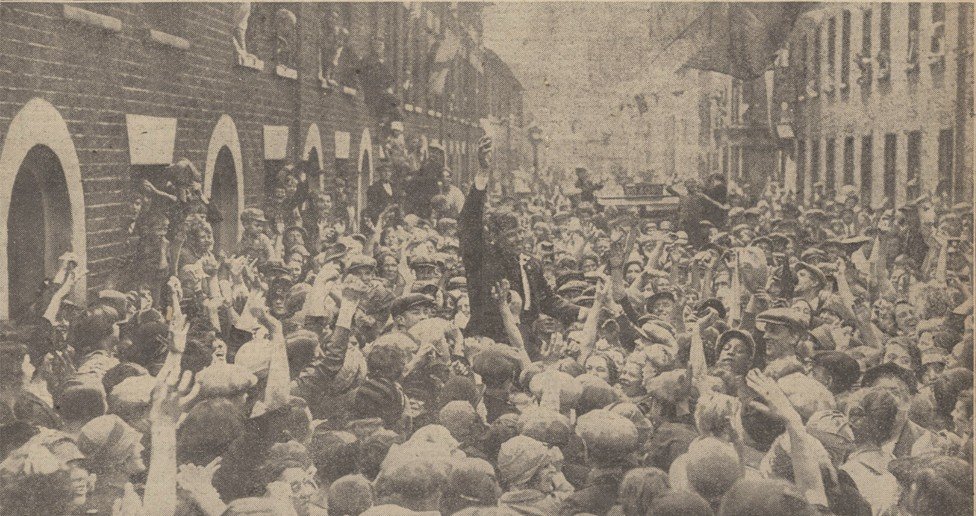
Edward was given an ecstatic welcome back in Nelson Street, in London where he lived and this historic picture from 1927 captures the euphoria.[15] This success would be just the start of a life-long fascination with the English Channel and he immediately started planning how he might swim in the opposite direction – the more difficult crossing from England to France. Training for this reverse crossing also began in earnest with a diet of ‘fish, bread and butter, and tea’ and by summer of 1928 he told the press that he was ‘fit enough to eat the Channel [and] I shall eat two pounds of steak before I start, and then no more food for six hours’.[16] He expected it to take him about 16 hours.
With all this going on and with his regular job, Edward was a busy man (and you can read about later English Channel exploits further on). Meanwhile, I can almost hear you Bristol Channel stalwarts thinking, this is all very interesting, but WHAT ABOUT THE BRISTOL CHANNEL? Well wait no more, this is what we have found out.
Bristol Channel Swim 8 July 1928 – ‘A Grim Struggle’ and on 30 July 1933, ‘Hardest Swim of My Life’
Eleven months after successfully swimming the English Channel in August 1927, we find Edward Temme staying in Cardiff as a guest of Mr. R.P. Green who was secretary of the Welsh Amateur Swimming Association (WASA). It was reported that Edward was very interested in Kathleen Thomas’ Bristol Channel swim (at that point she was the only person to have done it) and that he might have a go at it himself. In the meantime he intended to give an exhibition of various strokes used in his English Channel swim at a gala in Barry in aid of the St. Dunstan’s Institute for the Blind.[4] He was also going to fit in a water polo match with his British Olympic team taking on players representing the Rest of England. As we said before, a busy man!
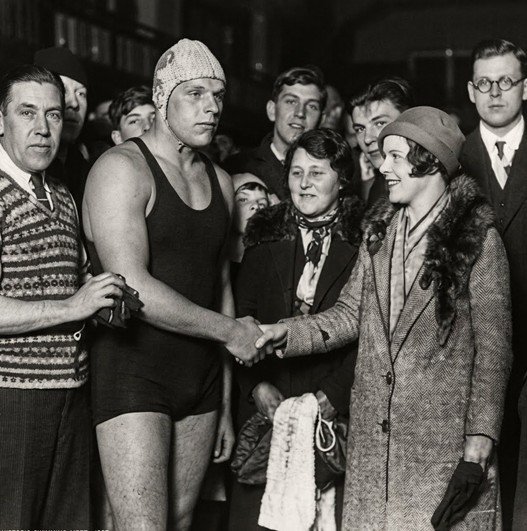
But what about the Bristol Channel? Well, once ‘he had surveyed the land, [he] would not be long in making up his mind’.[4] Sure enough, on Penarth slipway, at 2.25 on a Sunday morning a photograph from that day shows Kathleen Thomas, Bristol Channel conqueror, shaking Edward’s hand to wish him good luck (his trainer, Tom Storey is on the left of the picture).[17] Kathleen Thomas and her father Jack Thomas, senior, were to be in the accompanying motor launch along with two WASA officials while, Jack Thomas junior would pilot the rowing boat.[17] Despite the early start Edward was given ‘a hearty cheer’ from the nearby crowd and ‘he was off, using his powerful trudgeon stroke’.[18]
Swimming SSE and ‘guided by torch light from the bow of the small boat … the powerfully built young man, with arms bashing with monotonous regularity, ploughed his way along at a fast pace’.[18] All was going to plan and he was being carried along on the tide but off the cost of Steep Holm the crew in the boat noticed that he was having difficulty keeping to his course: while he was still swimming strongly and showing no signs of fatigue, ‘he was making little or no headway’.[18] After having a fortifying drink of cocoa (how British!) he struck a bad patch: ‘precious minutes were speeding by, and when at the end of an hour it was seen that he had only moved 100 yards nearer the coast it seemed that the venture was doomed to failure’.[18]
Were the Bristol Channel monsters lurking in the depths, secretly thinking, ‘English Channel, pargh! Let’s give him a taste of what we can do!’ But, to Edward’s credit, he was made of stern stuff; having taken two hours to swim ¾ of a mile, the tide turned and, guided by expert pilot, Jack Thomas, he was able to make full use of the tide sweeping towards his goal of the Old Pier at Weston. Still wanting to have the last laugh, those Bristol Channel monsters started pushing him away from the Pier and the boat crew realised that his only chance of reaching land was to make for St. Thomas’ head – about 2 ½ miles east of Weston. By now, Edward was ‘showing unmistakable signs of the severe strain imposed upon him in his efforts of the previous few hours, and twice he halted apparently in distress. He renewed his efforts, though once he was heard groaning as he appeared to lose distance. He struggled on grimly, and it was a herculean burst of speed that brought him within measurable distance of the rocks. A cry from his trainer, and Temme appeared to hurl himself on the rocks and make victory his.’[18] The monsters had relented, perhaps secretly admiring the ‘sheer grit, stamina and pace’ that had helped Edward overcome what had been ‘a grim struggle’.[18]
This successful swim was therefore only the second recorded crossing of the Bristol Channel and the first by a man (therefore also making him the youngest man at that point). With a time of 6 hours 35 minutes he had beaten Kathleen Thomas’ time, making him the fastest swimmer to date as well.
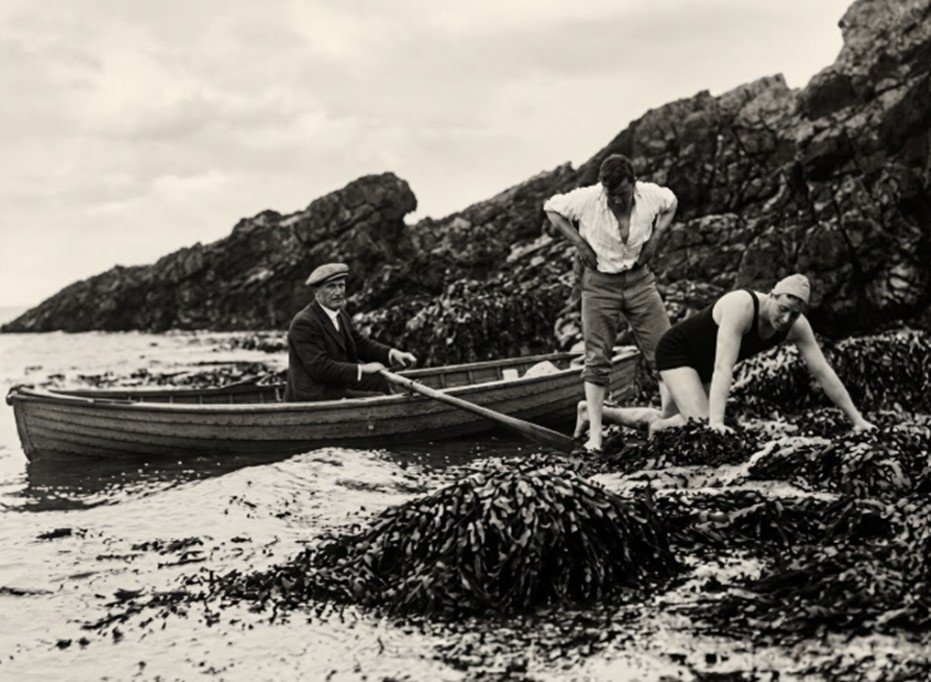
The photograph of Edward at the end of the swim in his raincoat (a far cry from modern dry robes!) shows him in Weston [18]. After a bath and a hot meal he was taken back to Penarth on a motor boat, telling the accompanying press ‘I did not have much in me when I finished up and I ended in worse condition than when I swam the English Channel. However, that may be due to the fact that I was travelling on Saturday morning and playing water polo in the evening.’[18] As for that time of no progress round Flat Holm, ‘he added with a smile, I am sick of the sight of that place’![18]
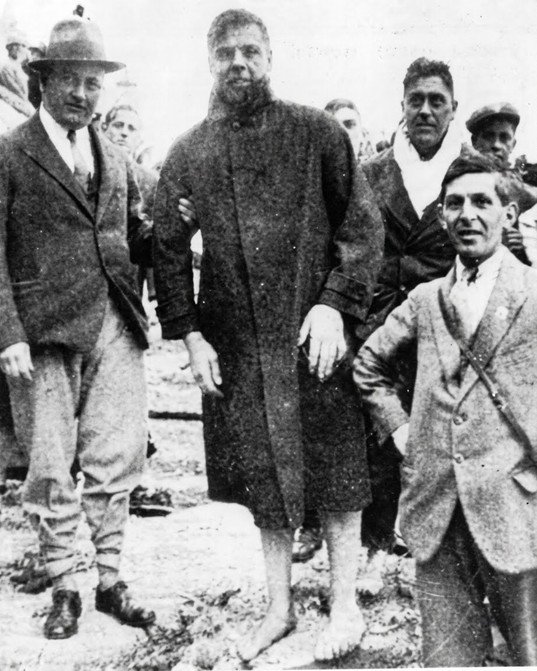
Jack Thomas, the pilot, was paid generous tributes by Edward Temme and his crew, while the WASA officials described the swim as ‘one of the most thrilling they had ever seen. It seemed a miracle that he beat the elements’.[18] But Tom Storey, Edward’s trainer, thought that the Bristol Channel was easier than the English Channel though he did say that ‘only a quick swimmer could accomplish the swim as the tides to Flat Holm had to be raced’ and if this could not be done in time then the swimmer ‘could never cross’.[18]
As for Edward himself, he was to tell the press that ‘my swim across the Bristol Channel was just a little practice. I was waiting for a polo match and just filled the time with a little swim’: this generated the headline ‘Swam [Bristol] Channel to Pass Time’![19] How those Bristol Channel monsters must have been gnashing their teeth at this tongue in cheek bravado and that they had let him off the hook! Seriously though and to be fair to Edward Temme and his trainer Tom Storey, they were swimming the ‘narrow end’ of the Bristol Channel (about 11 miles as the crow flies) so they might well have considered it ‘just’ an extended training session for their ultimate goal – the English Channel. In the late 1920’s, no-one had yet considered how to plot a course across the Bristol Channel as it got wider and wider and which would allow a swimmer to overcome the 14 metre tidal range. This feat of both navigation and swimming prowess would provide epic challenges that truly were comparable to the English Channel … but it would be a long time coming. You will have to look in the Bristol Channel Historic Project database to find out more.
We have already seen that even at the narrowest end of the Bristol Channel the treacherous currents had provided Edward with a considerable challenge that he only just overcame. He would be back for a second attempt on 30 July 1933. It is recorded in modern databases that he successfully made the crossing in 7 hours 5 minutes, a little slower than his previous time. But, this time, contemporary accounts of the crossing have proved more elusive with what is out there also seeming to be conflicted, for instance whether he swam from Wales to England or the other way round (which we think is a mistake, but if correct, would have been a first).[19] What little we have found out so far, is that Edward told the press that this second Bristol Channel swim was the ‘hardest swim I have ever had in my life … the waves gave me the sensation of swimming uphill all the time. The currents were exceptionally strong’.[20] Tantalisingly, that is all the article tells us about this particular swim although it does give the route as ‘from Penarth to a point near Weston’ which we believe is accurate. Can anyone tell us any more about this swim – if so get in touch.
In a much later interview with the press and when he was discussing the English Channel Edward talked about water conditions that made life especially difficult for the swimmer. At Monster Swims we knew just what he was talking about because we have been there as well in both the English and the Bristol Channels: Edward was spot on when he said, ‘biggish waves are not so bad – it’s the little chaps that go slap-slap-slap in your face that are the worst – after a few hours it’s like the Chinese dripping water torture, only more so’![28]
Edward Temme’s Later Career and Personal Life
Between Edward Temme’s two Bristol Channel swims in 1928 and 1933 he also had four failed attempts on the English Channel all trying to make the more difficult crossing between England and France.[21] We will tell you a little about these because it gives a flavour of the challenges of this sort of swimming whether it is the English or the Bristol Channel.
On 8 September 1928, two months after he had done that ‘little practice swim’ across the Bristol Channel, Edward set off for France; but after 8 hours 7 minutes in the water and in sight of Calais, he unexpectedly collapsed. He was so well greased that the boat crew could not hold him and he had to be ‘rescued with a line in a semi-conscious condition’[22] with another newspaper saying that he ‘was only rescued from drowning by his trainer in the nick of time’.[23] Fortunately, he soon recovered.
Another attempt on the English Channel in August 1932 again saw Edward having to give up, within 1 ½ miles of the French coast: ‘he found the water very cold and was suffering from the effects of low temperatures’.[24] It would not be until 1934 that Temme successfully made the crossing from Dover to France in a time of 15 hours and 54 minutes. The English Channel database of swims[21] holds a superb picture of Edward receiving the Dover Gold Cup on 29 October 1934 – a trophy which had been funded by public donation back in 1927 such was the interest in Channel swimming.
Water polo was also still a huge part of Edward’s life and we have already seen that he was selected for the British team at the Berlin Olympics in 1936. Although he retired from international competition soon after, he was still playing regularly. In 1939 he competed in the Nottingham team, the commentator telling us that the standard of play ‘was very scrappy … both teams were so busy watching 18 stone Temme …[and] his brilliant solo sprints – that both teams forgot all their knowledge of combination’.[25]
On the 1939 Register, Edward’s occupation was listed as a Baths Manager and Engineer in Nottingham, but with the onset of war he served in the Royal Ordnance Corps, being posted as a 2nd Lieutenant in 1943.[5] After the war, he became superintendent of the baths in Hampstead, London. A national newspaper pictured him in 1947 with a crowd of turbanned women doing their laundry at the baths; the article telling us that he knew a thing or two about ironing because, as officer-in-charge, he had been responsible for the laundry of 1,000 ATS girls in Germany![26]
Post-war, English Channel swimming was becoming popular again but by 1948 Edward Temme was still the only person to have swum it in both directions and, together with his Olympic achievements, he was still talked about as ‘Britain’s greatest aquatic star’.[27] Consequently, he remained a celebrity in and beyond the swimming world. In a humorous report from 1948, he is lauded as ‘The Great Temme … soaked in sea-cunning and swimming lore, now Aquatic Lord of the Hampstead Baths, London.’[28] This report gives us lots of insights into Edward’s motivation for English Channel swimming: ‘the point of it all, said the Great Temme, is that to swim the English Channel is still regarded in swimming circles throughout the world as a Blue Riband feat … the pressure of the currents makes it the most difficult swim there is. It is a question of prestige – personal and national.’[28]
There were plenty of people at the time who must have felt the same motivation as Edward and by the end of the 1940’s he was regarded as the ‘foremost trainer of English Channel swimmers’[29] coaching many aspirants who wanted to follow his example and who sought his advice at Hampstead Baths and then when he was superintendent of Newport Municipal Baths from 1950. His role as a swimming trainer also had a big impact on his personal life.
In 1929 he had married Evelyn Clare Pettipiere in Lower Edmonton, London, but she divorced him in 1950 because of his uncontested adultery with a Dutch spring swimming champion Wilhelmina (Willi) van Rijsel who he had been coaching. The couple were married in August 1950 at Folkestone Registry office. Willi made several unsuccessful attempts to cross the English Channel: in 1950, Edward organised an English Channel swim on behalf of the Daily Mail and asked the secretary of the Southern Counties Swimming Association, Mr Price, to come along, Edward’s wife Willi was making her third English Channel attempt in this 1950 challenge but had to retire with cramp and a violent headache [30] … leading Mr. Price to tell the press, ‘I would never undertake to take another woman across the Channel. It is not the place for them’.[31] Several women had in fact already proved him wrong in the 1920’s while Florence Chadwick was also able to thumb her nose at his opinion when she became the first woman to swim the English Channel both ways in 1951.[32] Here at Monster Swims we do agree that having the right mental attitude is critical to success …and have piloted plenty of women (and girls) who have proved it in spades!
Despite his expert coaching, Willi Temme never did succeed in crossing the English Channel but she achieved many other swimming challenges such as breaking the women’s time record for swimming Lake Windermere and also being the first woman to swim it both ways: Monster swims could tell a tale about swimming this one too! Edward’s marriage to Willi did not last and they divorced in 1961. Edward dies in June 1977 while he was in Padua, Italy but had directed in his will that his ashes be scattered at sea off the Dover coast.[33] With no gravestone or memorial plaque, genealogical records tell us that Edward’s memory is ‘almost forgotten’ – except for Edward Temme Avenue in Newnham, East London. We hope that this Monster Swims Historical Project restores Edward to his rightful place as a giant in the swimming world – even if he did think the Bristol Channel was just a little practice swim!
Edward Temme’s Legacy
Although Edward Temme was only the second person to swim the Bristol Channel and had the accolade of being the first man to do so, it is clear from our account that his own personal identity and sense of achievement came from his success in the English Channel, particularly the hard-won feat of being the first to swim across in both directions. Allied to his Olympian status, he truly was a Colossus of the swimming world.
And for all you Bristol Channel aficionados who want the last word. We do think that Edward probably saw the Bristol Channel as a particularly trying training swim. However, this might have been totally different if his swimming days coincided with the modern day, much longer Bristol Channel swims or the Original Triple Crown swim [that is, the English Channel; the North Channel, Scotland/Ireland; and the Bristol Channel, Porthcawl/Devon – which has to exceed 27 km]. Kevin Murphy was the first to claim this Original Triple Crown when he finished with the Bristol Channel Swim in 1971. We think that Edward Temme would have found this challenge very much to his liking as it would have given him plenty to compare with the English Channel.
Discrepancies in the Historical Record
* Some sources cite Edward Temme as swimming the Bristol Channel in both directions, but the evidence does not seem to support this.
* Some sources also create the impression that Edward Temme swam the English Channel back to back. This is incorrect, he was the first to swim it in both directions but this was on separate occasions.
Historical Research
This article draws on unpublished historical and genealogical research by Yvonne Chapman. We believe that we have taken reasonable steps to ensure that we do not infringe any rights and usages as we develop this public access, not for profit project. Where we have used any historic pictures that we believe are in the public domain, these may have been enhanced by AI – simply to make them clearer for our audience. We are grateful for advice from the National Library of Wales, the London School of Economics digital library and other public bodies about images out of copyright and now in the public domain. If you can contribute to this historical project; if you want to comment; or if you spot any errors or issues, please contact us at Monster Swims. Meanwhile, happy reading and happy swimming!
Sources
Image note: Selected historical photographs have been AI enhanced for clarity. Image sources are identified in the references below.
[1] Historic cigarette card image of Edward Harry Teme, belonging to Monster Swims
[2] National Portrait Gallery, npg.org.uk, item D48968,- cigarette card in colour relief, half tone, printed by Gallagher Ltd. in 1936
[3]Dover Museum, Between Wars, Edward Harry Temme section. https://www.dovermuseum.co.uk/Exhibitions/Channel-Swimmers/Between-Wars.aspx
[4] Western Mail, 4 July 1928
[5] https://www.ancestry.co.uk; including accessing census information and the 1939 Register
[6] WesternTimes, Friday 15 July 1927
[7] Olympedia: https://www.olympedia.org.athletes/53954
[8] Chelmsford Chronicler, Friday 2 August 1927
[9] Western Times, 15 July 1927
[10] Shields Daily News, Tuesday 12 July 1927, p3
[11] Chelmsford Chronicler, Friday 12 August 1927
[12] Kentish Express, Saturday 13 August 1927, p7
[13] Yorkshire Post and Leeds Intelligencer, Saturday 6 August 1927
[14] Cornishman, Thursday 11 August 1927
[15] Sunday Mirror, 7 August 1927, p1
[16] London Evening News cited in Belfast Telegraph, Thursday 26 July 1928
[17] historic image of Kathleen Thomas, Edward Teme and others on Penarth slipway, Western Mail, 9 July 1928. This reports also shows three other historic pictures of the Bristol Channel swim, including Edward crawling from the water at St. Thomas’ Head on the English side of the Bristol Channel
[18] Weston-super-Mare Gazette, and General Advertiser, 14 July 1928
[19] Belfast Telegraph, Thursday 26 July 1928
[20] Pinang Gazette and Straits Chronicle, 19 August 1933, p6, ‘Bristol Channel – Hardest Swim of My Life’?:
https://eresources.nlb.gov.sg/newspapers/digitised/article/pinangazette19330819-1.2.28
[21] English Channel swims database: channelswimmingdover.org.uk
[22] Daily Express, Monday 10 September 1928, p11
[23] Western Times, Friday 14 September p3
[24] East End News and London Shipping Chronicle, Friday 19 August 1932
[25] Leicester Evening Mail, Tuesday 27 June 1939, p13
[26] Daily Mirror, 1 May 1947
[27]Leicester Chronicle, Saturday 21 August 1948, p7
[28] Weekly Dispatch (London), Sunday 1 August 1948, p4
[29] Daily Mirror, Saturday 13 August, 1949
[30] Wolverhampton Express and Star, Monday 28 August 1950, p11
[31] Uxbridge & West Drayton Gazette, Friday 1 September 1950
[32] Reveille, Friday 5 September 1952, p4
[33] Evening News (London), Monday 16 October 1978, p8
Further Reading
* Bristol Channel Swimming Association, Penarth to Weston Super Mare. Modern register, including Temme’s reverse 1933 entry. https://www.bcswimmers.com/penarth-wsm
* Team GB, Ted Temme, athlete biography: https://www.teamgb.com/athlete/ted-temme/396hhX6xGA7rk1wQy9IZs3
 BRISTOL CHANNEL SWIMMING · HISTORICAL ARCHIVE · 1927–2027