
Jane Luscombe — Following Her Grandfather Across the Channel
At fifteen, the Jersey swimmer carried a family ambition across the Bristol Channel — and made a record of her own.
A Channel in the Family
When fifteen-year-old Jane Marie Luscombe set out from Glenthorne Cove on 19 August 1976, she was taking on a stretch of water that already held a special place in her family’s history. Almost half a century earlier, her grandfather Harry Luscombe had swum across the Bristol Channel from Penarth to Weston-super-Mare. Jane later identified his achievement as the inspiration for her own attempt. Now it was her turn, on a different crossing: from the North Devon coast to Porthcawl. [1, 2, 3]
Harry’s crossing belonged to the pioneering years of Bristol Channel swimming. His granddaughter’s would add another chapter to that family connection, but Jane arrived with achievements of her own. Just fourteen days before her Bristol attempt, she had completed a swim around Jersey that lasted more than thirteen hours. August 1976 was becoming a remarkable month for the teenage swimmer. [2, 3, 4]
From Jersey to Glenthorne
Jane’s swimming developed within Jersey’s long-distance swimming community. The island’s club records place her Round Jersey swim on 5 August 1976, in 13 hours 5 minutes. Her name is the second entry in the club’s roll of solo circumnavigations, following Denize le Pennec. Before she ever reached Glenthorne, she had already demonstrated the endurance needed for a long day at sea. [4]
There was a strong family presence in that swimming world, too. Her mother, Marie, would be club president around the time of Jane’s English Channel success in 1978. Alongside the example of her grandfather, Jane had a connection to the people and organisation supporting Jersey’s long-distance swimmers. [2, 7]
The Bristol crossing took her away from the waters around her home island and to the cove below Glenthorne House, close to the Devon–Somerset boundary. Across the Channel lay the Welsh coast and her destination at Porthcawl. The contemporary British Long Distance Swimming Association record names the course as Glenthorne Cove to Coney Beach. [1]
A Record Across the Bristol Channel
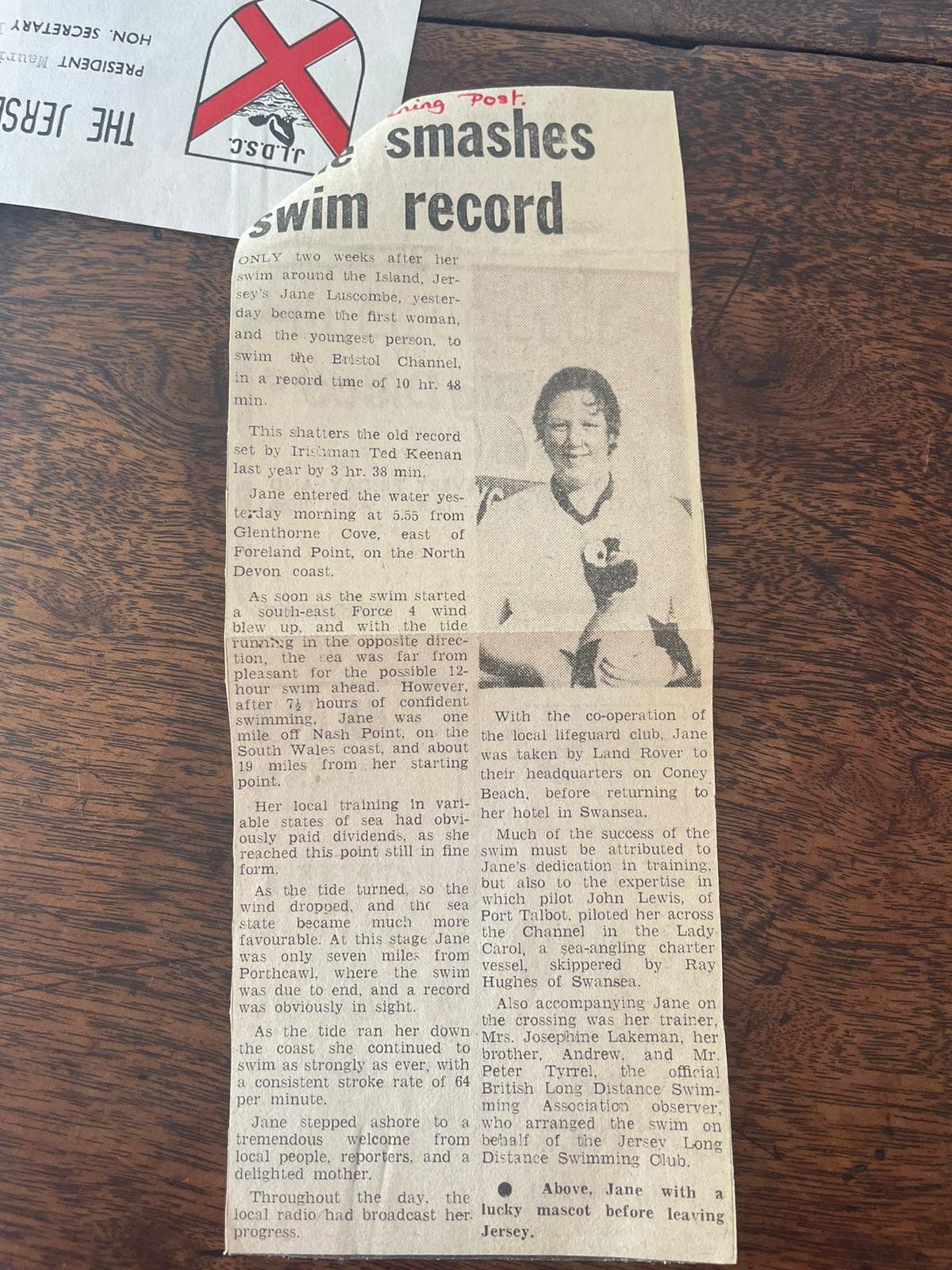
Jane entered the water at 5.55 in the morning. The newspaper account describes a south-easterly force four wind rising against the tide, making the opening hours rough. Her escort was the Lady Carol, skippered by Ray Hughes of Swansea, with John Lewis of Port Talbot guiding the crossing. Alongside Jane were her trainer, Josephine Lakeman, her brother Andrew and BLDSA observer Peter Tyrell. [9, 10]
Seven and a half hours into the swim, the report placed her about a mile off Nash Point, still swimming strongly. As the tide turned, the wind eased and conditions improved. Porthcawl was coming within reach. The report describes a steady stroke rate of 64 a minute as the tide carried her along the Welsh coast. [9]
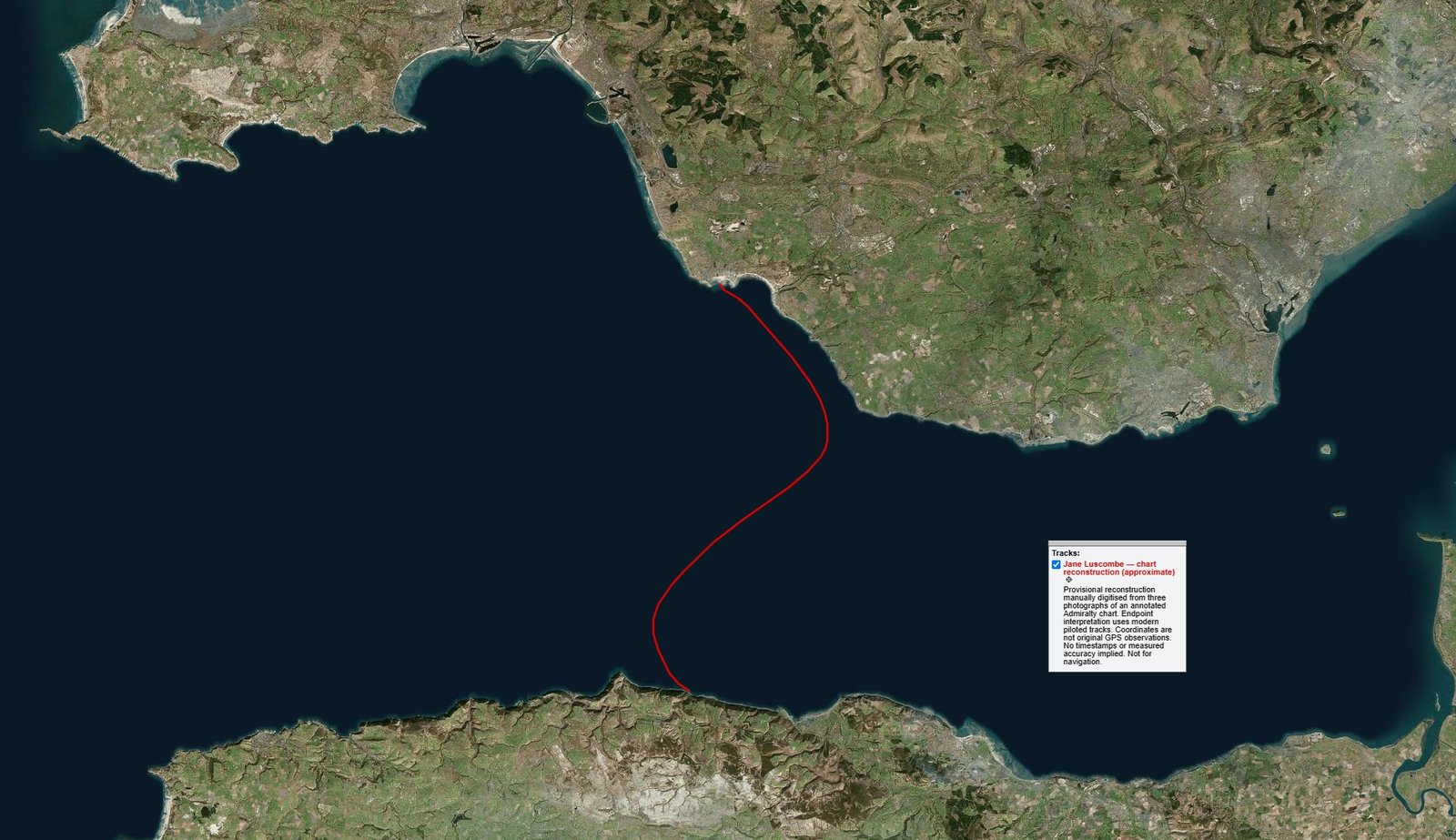
The surviving annotated Admiralty chart gives this part of Jane’s story a visible shape. Its plotted line curves away from the English shore, makes a broad sweep eastward through the Channel, then turns back towards Porthcawl. Handwritten positions and times preserve something of the work of following a swimmer across tidal water, long before a GPS track could record the journey automatically. [8]
The photographs allow an approximate reconstruction of that line, although they cannot establish every plotted position or the precise shore connections. What they do show is a crossing with a substantial curve, rather than a straight line between two beaches. The chart is a valuable companion to the brief result recorded in the official table. [8]
Jane completed the crossing in 10 hours 46 minutes. In its 1976 annual report, the BLDSA recorded her name, the date, the Glenthorne Cove–Coney Beach course and a distance of nineteen miles. Beside the result it placed the words “Allcomers Record”. The Bristol Channel Swimming Association’s family account also identifies Jane as the first woman to complete the longer North Devon–Porthcawl crossing. [1, 2]
Ashore, Jane was met by local people, reporters and her delighted mother. Local radio had followed her progress during the day. The lifeguard club helped take her by Land Rover to its headquarters on Coney Beach before she returned to her hotel in Swansea. After almost eleven hours in the water, the crossing ended with a welcome. [9]
At fifteen, she had followed her grandfather across the same Channel while establishing a result of her own on a different route. Her Jersey and Bristol swims were separated by only a fortnight: two major sea swims, both completed before the end of the same summer month. [1, 3, 4]
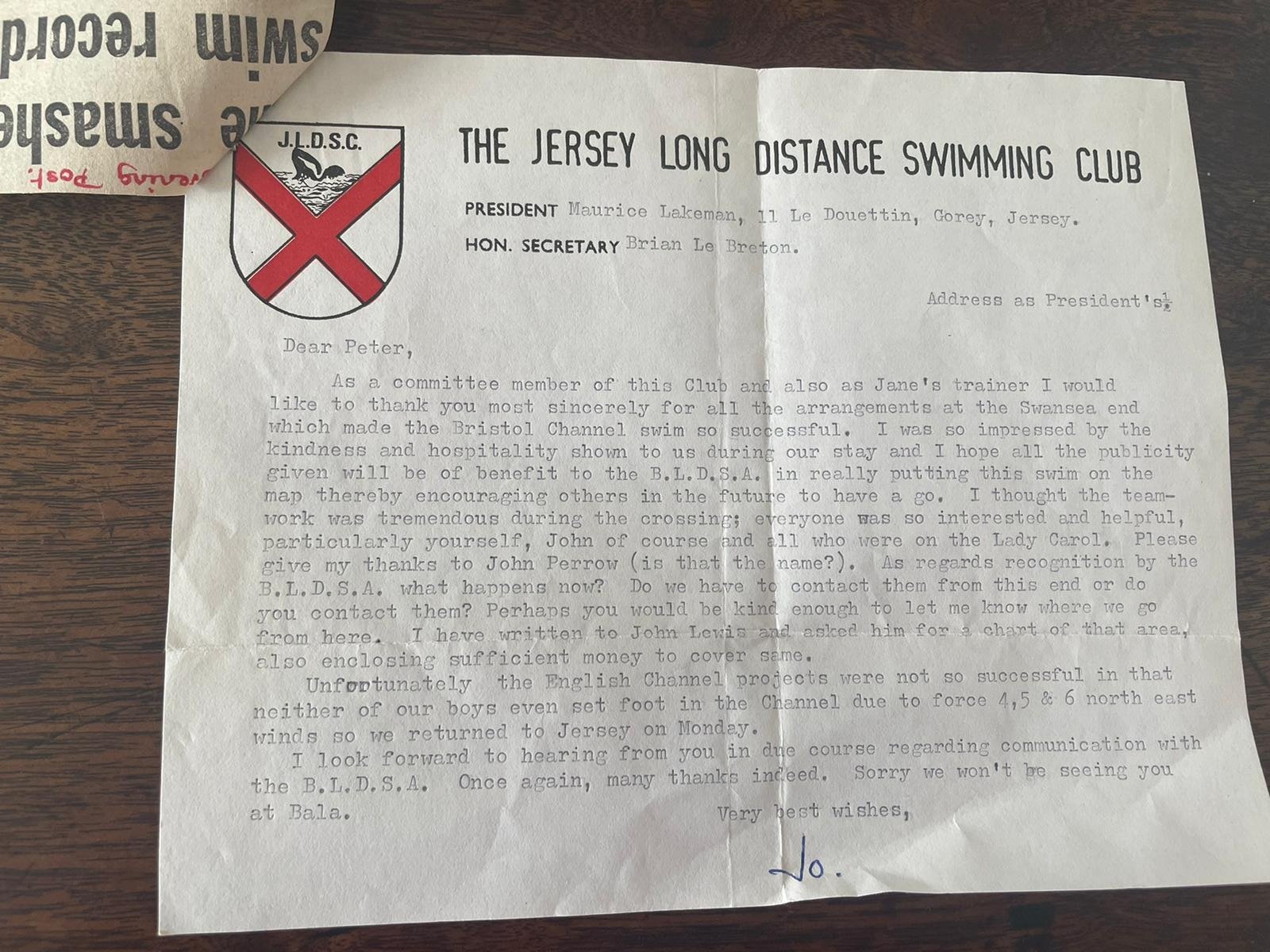
A thank-you letter from Jane’s trainer, signed Jo, gives a glimpse of the teamwork behind the result. She praised the arrangements, hospitality and everyone aboard the Lady Carol, and asked how to secure BLDSA recognition. The record in the annual report was the formal outcome of a swim that had depended on many hands. [1, 11]
Beyond That Summer
Jane continued to build her long-distance career after Bristol. In 1977 she completed Windermere in 5 hours 36 minutes, returning in 1978 with a time of 5 hours 22 minutes. The Jersey club also records a separate fifteen-mile Windermere International swim in 1978, completed in 9 hours 5 minutes. [5]
Then came the English Channel. In 1978, two years after her Bristol crossing, Jane completed that swim in 11 hours 53 minutes. The progression from Jersey to Bristol and then the English Channel shows how much she achieved within those few years. [4, 6]
In later correspondence, preserved under her married surname Skinner, Jane returned to the family story behind her Bristol swim. She confirmed that she had been fifteen and supplied the date of Harry’s crossing: 15 September 1929. Those recollections connect the formal swimming records to the family whose two generations had taken on the Channel. [3]
A Place in the Channel’s History
Jane’s achievement is preserved in several forms: a line in a contemporary recognition table, a plotted course on a paper chart, club rolls and her own later recollections. Together they tell the story of a teenage swimmer who drew inspiration from her grandfather and earned her own place in Bristol Channel history. [1, 2, 3, 8]
Harry’s swim had given the family a story to pass down. In August 1976, Jane gave it another crossing. [1, 2, 3]
Notes on the Historical Record
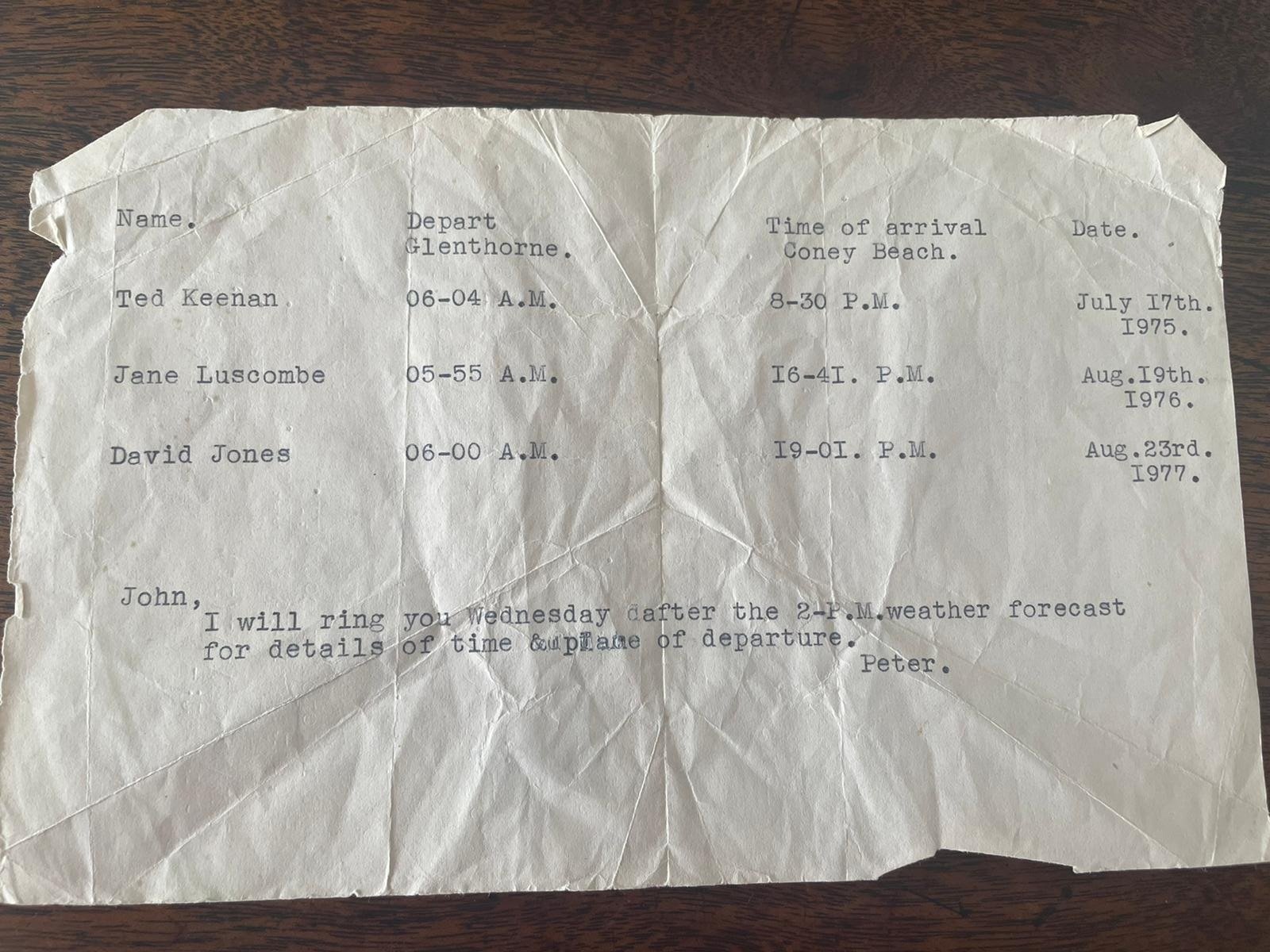
Crossing time. The newspaper cutting and the Jersey club’s later Other UK Swims page give 10 hours 48 minutes. This article uses 10 hours 46 minutes, supported by the contemporary BLDSA table, the BCSA account and the surviving timings sheet: departure 05:55 and arrival 16:41. The reason for the two-minute difference in the other accounts remains unexplained. [1, 2, 5, 9, 10]
Route and distance. The BLDSA names Glenthorne Cove–Coney Beach; the BCSA narrative describes Foreland Point near Glenthorne to Porthcawl. Those start descriptions should not be treated as geographically identical. Photographs of the annotated chart have now been examined, but exact shore connections remain an interpretation. Nineteen miles is the historical course figure in the BLDSA table. The provisional digitised line is approximately 35 km; that reconstruction is not an independent measurement of Jane’s distance swum. [1, 2, 8]
Age and record claims. Jane’s later correspondence confirms that she was fifteen. “Allcomers Record” is the designation in the 1976 BLDSA table for the named crossing. Neither this designation nor her age alone establishes an all-time youngest-crossing claim or a present-day record. [1, 3]
Harry Luscombe’s date. The article follows Jane’s confirmation of 15 September 1929. A conflicting 1920 date appears in part of the BCSA family narrative. [2, 3]
Sources and Further Reading
[1] BLDSA Annual Report 1976, PDF p. 14, printed p. 10, Honorary Recorder’s recognition table. Visually inspected: Jane Marie Luscombe, 19.8.76, 10.46.00, Glenthorne Cove–Coney Beach, Allcomers Record. https://bldsa.org.uk/wp-content/uploads/BLDSA-Annual-Report-1976.pdf
Folder copy: https://drive.google.com/file/d/1poOllC6EYSTRDj5IrGXY1CWrUkDaZ54z/view
[2] Bristol Channel Swimming Association, The Luscombes. Family narrative and historical result. https://www.bcswimmers.com/theluscombes
[3] jane luscombe.jpg, screenshot of correspondence dated 16 and 19 September 2024, supplied in the project folder and inspected. Retrospective first-person evidence for age and Harry’s date; private contact and family details are not reproduced here. https://drive.google.com/file/d/1hnfX5rUTh8s4-jlD0lpgK8a1HA3nxJYg/view
[4] Jersey Long Distance Swimming Club, Round Jersey Solo, 5 August 1976 entry. https://www.jerseyseaswims.org/round-jersey-solo.html
[5] Jersey Long Distance Swimming Club, Other UK Swims. Bristol duration conflict and Windermere results; page inspected. https://www.jerseyseaswims.org/other-uk-swims.html
[6] Jersey Long Distance Swimming Club, English Channel Solo, 1978 entry. https://www.jerseyseaswims.org/english-channel-solo.html
[7] Jersey Evening Post, “50 years of making history”, 21 June 2024. Retrospective club history inspected. https://jerseyeveningpost.com/sport/more/swimming/2024/06/21/50-years-of-making-history/
[8] Photographs of the annotated Bristol Channel Admiralty chart, supplied in Jane Luscombe’s research folder: WhatsApp Image 2026-10-13 at 20.56.55.jpeg and the two close-ups labelled (1) and (2). Examined for this revision. The accompanying GPX is a provisional reconstruction, not an original GPS recording.
[9] Newspaper cutting reporting Jane’s crossing; publication date and full masthead not visible Supplied archive photograph, visually inspected for this revision.
[10] Typed Glenthorne–Coney Beach timings sheet, listing crossings in 1975, 1976 and 1977 Supplied archive photograph, visually inspected for this revision.
[11] Jersey Long Distance Swimming Club letter to Peter, signed Jo, thanking the Bristol Channel escort team Supplied archive photograph, visually inspected for this revision.
Further evidence sought: Jane’s original Bristol observer report and certificate, identification of the chart’s annotations, and the newspaper cutting’s publication date and full masthead.
 BRISTOL CHANNEL SWIMMING · HISTORICAL ARCHIVE · 1927–2027